
lindy ai vs n8n: My Deep Hands-on Comparison 2026
If you need a digital assistant that can draft emails, summarize meeting action items, or semi-automatically update your CRM using spoken-style instructions, choose Lindy AI. If you need to build a high-concurrency, low-tolerance-for-error automation pipeline with complete control over data privacy, n8n is your choice.
In my own business, I deal with various automation logic and AI agents on a daily basis. Today, I will share the actual experiences my colleagues and I had using Lindy AI and n8n. I feel that these two tools take completely different paths: one treats AI as an extension of personal thinking, while the other completely transforms workflows into a deterministic assembly line.
This hands-on evaluation aims to help everyone make a clearer choice between lindy vs n8n.
n8n vs lindy: Quick Comparison
Before diving into the deep showdown, let’s quickly compare the core details of n8n vs lindy using the table below:
| Core Metric | Lindy AI | n8n |
|---|---|---|
| Product Positioning | Personal assistant and lightweight AI Agent builder platform | Developer-friendly, code-optional automation engine |
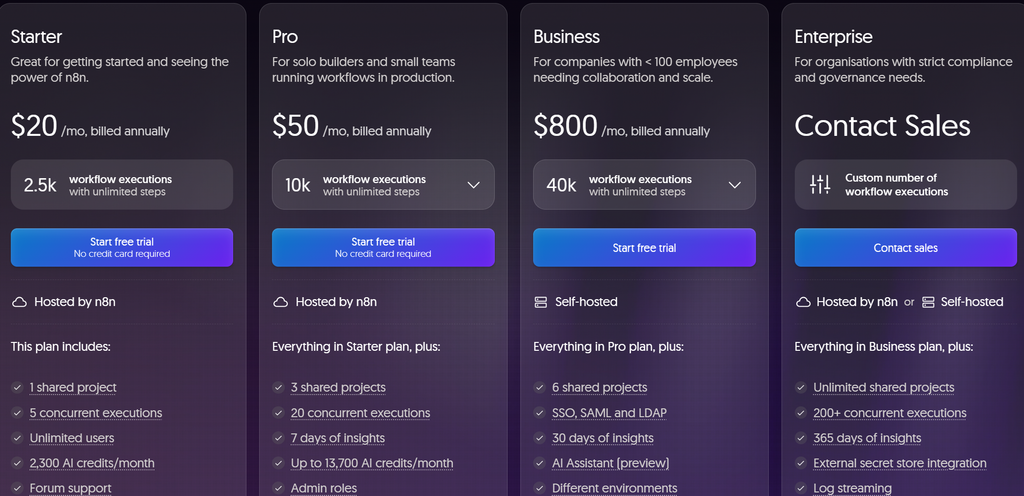
| 2026 Pricing Tiers | Free version (400 credits); Plus plan $49.99/mo; Pro plan $99.99/mo; Max plan $199.99/mo | Community edition (self-hosted) $0/mo; Cloud Starter plan $24/mo; Cloud Pro plan $60/mo |
| Billing & Consumption Model | Billed by opaque credits, non-transparent, no rollover | Billed by Execution (workflow runs), regardless of internal steps |
| Core Advantages | 60-second natural language agent generation; Gaia voice calls; built-in deep CRM sync | Allows embedding JS/Python to write Code nodes; supports local deployment; has visual debugger |
| Free Version Limitations | 400 credits are barely enough for testing; runs out quickly once touching advanced APIs | Community self-hosted edition has zero functional limits; you only pay for your own server hardware |
| Hidden Pitfalls | Out-of-control error loops will run endlessly and drain your credits; no native debugging mechanism | 5-minute polling triggers will quickly exhaust the 2,500 executions limit of the Cloud Starter plan |
| Best For | Non-technical founders, sales heads, global freelancers | Indie hackers, global expansion tech teams, privacy-first agencies |
lindy ai vs n8n:The Real Breakdown
lindy ai vs n8n: The Gap in Workflow Construction Efficiency and Customization
In terms of construction speed, Lindy AI’s natural language interaction lets you quickly deploy a simple Agent within 60 seconds, but when facing complex business connections and fine-grained logic, n8n offers unparalleled control.
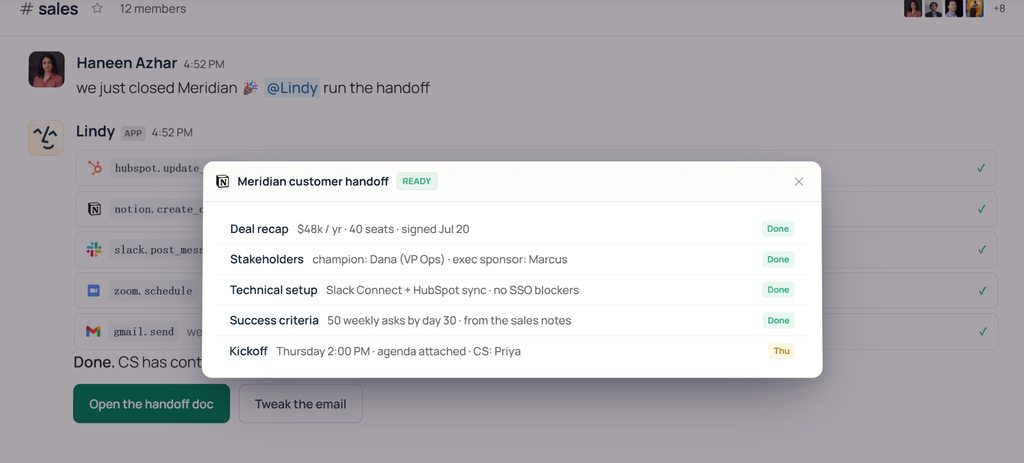
Lindy AI’s building method is highly intuitive and exceptionally friendly to those with zero technical background. I tested it by having it monitor a support inbox; I only had to enter a single prompt: “Monitor support inbox, answer questions with FAQ, send a Slack ping if you get stuck.” Within 55 seconds, it automatically connected Gmail and Slack for me. This “natural-language-as-an-app” experience is indeed satisfying.
But as soon as your business involves even a slight amount of complex data transformation, Lindy AI’s black-box mechanism becomes a nightmare. It has no native debugging view; when the Agent throws an error, your only option is to rewrite the prompt and pray it understands. This leaves it currently lacking the flexibility needed for micro-configurations.
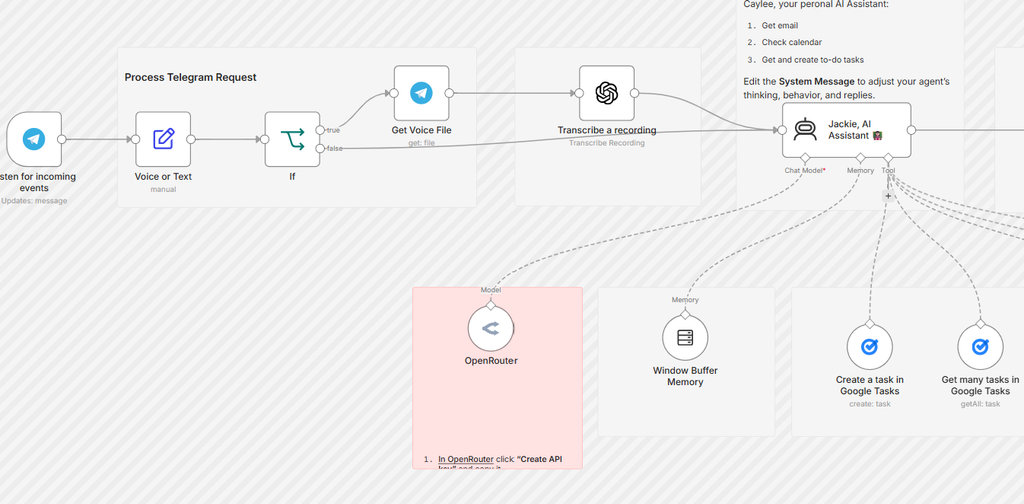
In contrast, n8n requires you to understand a little bit of Webhooks and JSON structures, but it is extremely flexible. n8n’s visual execution view is highly intuitive, making the inputs and outputs of every single run crystal clear at a glance.
If you find that a complex branch cannot be resolved with visual nodes, you can directly pull up a Code node and write a few lines of JavaScript or Python to achieve precise data cleaning. This coding capability gives technical teams complete control.
n8n vs lindy: A Comparison of Deep AI Integration and Complex Task Processing Quality
If your business has a very low tolerance for error, n8n’s deterministic branching logic ensures that AI nodes operate within safe guardrails, whereas Lindy AI is much more prone to hallucinations and failures when handling non-standard tasks.
Lindy AI natively integrates the Gaia low-latency voice Agent, enabling direct call placement and reception, and can even seamlessly sync meeting summaries to HubSpot CRM.
However, when facing high-intensity business and compliance communications, it lacks fine-grained conditional constraints. Consequently, in practical applications, it occasionally makes misjudgments, leading to unacceptable compliance risks such as sending emails to the wrong addresses or archiving information incorrectly.
n8n follows an exceptionally rigorous engineering-oriented AI approach. It natively integrates models like OpenAI, Anthropic, and even ecosystems like LangChain, allowing you to restrict large language model outputs via conditional logic nodes.
For example, I usually configure a workflow like: “AI automatically drafts a reply -> If confidence is below 85% -> Trigger a manual review routing.” This logic of combining LLM flexibility with the certainty of software engineering is far more stable in actual production than completely relying on AI decision-making.
lindy vs n8n : Running Costs
From the perspective of long-term billing transparency, n8n’s per-Execution billing model is far more cost-effective and predictable than Lindy AI’s vague credit-based billing.
Lindy AI uses a classic, non-transparent credit consumption model. Although the Plus plan is $49.99/mo, you cannot accurately predict how many credits a complex AI task will deduct each time.
Even worse, if your Agent gets caught in an infinite loop (for instance, an external API error causing it to repeatedly resend emails), it could easily burn through your entire monthly credit allocation overnight.
Meanwhile, n8n bills based on the number of Executions. No matter if your workflow chains 10 or 100 nodes, running it once counts as exactly 1 Execution.
Taking one of my previous lead scrubbing workflows as an example: it consisted of 9 steps and needed to run 10,000 times a month. If using a traditional platform that bills per Task, the cost for 90,000 tasks would be painful. However, in n8n, this only consumes 10,000 Executions, which is easily covered by the €60/mo Pro plan, significantly reducing long-term operational costs.
If you have a basic operations background, you can directly use Docker to self-host the Community Edition. This brings software fees down to zero, leaving you to cover only the very low cost of VPS server hardware.
lindy vs n8n Weaknesses and Limitations
| Crucial Pain Points Comparison | Lindy AI | n8n |
|---|---|---|
| Major Technical Failures | OAuth authorization frequently expires; Gmail labels occasionally fail, generating blank labels | Extracting data from complex historical nodes is highly tedious and error-prone |
| Interruption Risks | Agent gets lost when errors occur, running endlessly in the background and draining credits | Under self-hosted mode, OAuth 2.0 requires highly strict SSL/HTTPS configuration |
| Customer Support | Starter plans lack instant customer support; refund policy is highly rigid with a poor user experience | Parts of the official documentation are missing or superficial, relying heavily on community forums |
Lindy.ai Weaknesses
What gives me the biggest headache is the stability of its Google OAuth authorization. Its token frequently expires when running recurring triggers, causing my workflows to disconnect in the middle of the night.
Furthermore, its Gmail addLabel action has hit bugs multiple times when handling specific archiving tasks, applying a blank “undefined” label and causing me to miss highly important client emails.
n8n Weaknesses
As n8n requires strict OAuth callbacks, you must configure your own HTTPS certificates and reverse proxies, which is an absolute nightmare for non-technical users.
Additionally, many users on Reddit complain that referencing n8n’s data structure after complex Code or Merge nodes often triggers errors and loses preceding node data due to changes in the JSON schema.
FAQ
Can Lindy AI completely replace n8n in 2026?
Absolutely not. Lindy AI focuses on acting as a conversational “digital employee” for human-to-computer interactions. It excels at handling unstructured tasks like daily emails and summarizing meetings.
However, it cannot handle backend database read/write actions or complex data flattening. For these production-grade scenarios, only n8n’s hybrid and Code nodes can deliver a safe execution.
Which tool is more cost-effective for high-frequency automation tasks, lindy vs n8n?
n8n is significantly cheaper. Lindy AI’s opaque credit limits will exhaust rapidly under tens of thousands of daily pollings.
On the other hand, n8n bills per Execution, and its self-hosted version has zero licensing fees, making it perfectly suited for high-frequency, complex scaling.
Which is more secure for handling sensitive customer data, n8n vs lindy?
Self-hosted n8n is the absolute security winner. While Lindy AI is SOC 2 certified, it remains a third-party cloud-hosted platform.
If your global business involves strict medical, financial, or compliance data, running your own self-hosted n8n Community Edition ensures all data remains in a closed loop on your local server.
Decision Guide: lindy vs n8n Ultimate Verdict
Choose Lindy AI if you need to quickly deploy a digital assistant for daily tasks

If you have zero technical background and just want to configure a digital worker to draft emails, organize your calendar, or extract action items, Lindy AI’s no-code experience is perfect. It lets you assign work in plain English, saving you from messing around with API documentation.
Choose n8n if you need to build highly customized, low-tolerance-for-error data pipelines
If you are an indie hacker, part of a technical team, or need to build highly complex, production-grade pipelines where errors are not an option, n8n is the only way to go. Its execution-based billing, Code nodes, and self-hosting capability keep your system running stably at an incredibly low cost.
Avoid both Lindy and n8n if your business heavily relies on direct integrations with massive niche SaaS tools
While both tools have growing integration ecosystems, neither has native connector coverage that matches the legacy giants. If your operations rely on thousands of highly obscure, cold-market SaaS platforms and you don’t want to write custom API integrations, sticking with Zapier or Make is a much safer bet.