
HeyGen vs Arcads: Review After Months of Use 2026
By Clara Dupont , Edited & Published By Toolvs Team
If your goal is to pump out dozens of UGC-style, TikTok-friendly conversational ads every day for relentless ad testing, and you have a healthy budget, Arcads is your tool. But if you prioritize realistic avatar rendering, need high-fidelity multilingual translation, or are creating professional product demos — all while keeping an eye on cost control — HeyGen is the superior choice.
As a former video ad media buyer, my daily grind revolved around testing massive volumes of video creative. The golden rule of ad testing is simple: it’s all about the “hook” and testing different avatar faces. Doing this effectively requires massive output. Having paid for subscriptions on both HeyGen and Arcads and tested them extensively, I’ve put together this deep dive comparison of HeyGen vs Arcads to help you make the smartest choice for your business.
HeyGen vs Arcads AI: 2026 Core Feature Comparison
To help you make an informed arcads ai vs heygen decision, I compiled the latest 2026 parameters.
| Comparison Metric | Arcads AI | HeyGen |
|---|---|---|
| Product Positioning | UGC Ad Video Generator | Browser-based AI Video Avatar Platform |
| Target Audience | E-commerce & app media buyers who need to mass-test ad creatives | International brand marketers, corporate trainers, and product demo creators |
| Actor Library Size | 1000+ Avatars (Creator Plan) | 200+ Stock and Custom Avatars |
| Supported Languages | 100+ Languages and Accents | 170+ Languages with ultra-precise accent cloning |
| Video Resolution | Supports up to 1080p | Free: 720p; Paid: 1080p; Enterprise: 4K |
| API & Integrations | Pro / Custom plans only; supports mcp.arcads.ai | Pro & Scale plans (credits-based) |
| Audio Engine | Built-in AI voice engine | Deeply integrated ElevenLabs acoustic models |
| Custom Avatars | Pro & Custom plans only (requires high-res footage) | Creator & Pro plans support instant cloning and professional custom avatars |
| Cancellation Policy | Requires 72-hour notice, otherwise auto-renews and bills | Easy self-serve cancel in dashboard, effective next billing cycle |
| Pricing Entry Point | Starter: $110/mo (Promo: $77); Creator: $220/mo | Creator: $29/mo ($24/mo billed annually); Business: $149/mo |
HeyGen vs Arcads: The Review Across 3 Crucial Metrics
Round 1: Workflow & Production Efficiency
When it comes to mass video production and overall workflow speed, Arcads takes the crown.
In ad campaigns, a typical challenge is testing the exact same script across multiple avatar faces and languages. Arcads solves this beautifully with its new node-based canvas Workflows. I can simply paste my ad copy into the workflow canvas, connect it to 20 different avatars, and generate dozens of video variations with a single click.
Furthermore, Arcads features a dedicated MCP connector. This allows me to use Claude to call its APIs directly via code or prompt structures to generate videos at scale.
By contrast, HeyGen operates on a traditional slide-by-slide timeline. In their AI Studio, you have to manually adjust and stitch scenes together slide by slide. While this is excellent for crafting highly detailed brand demos, it becomes tedious and repetitive when you need to pump out dozens of ad creatives a day.
Round 2: Video Fidelity & Lip-Sync Quality
When it comes to skin textures, micro-expressions, and natural lip-syncing, HeyGen is the undisputed king.
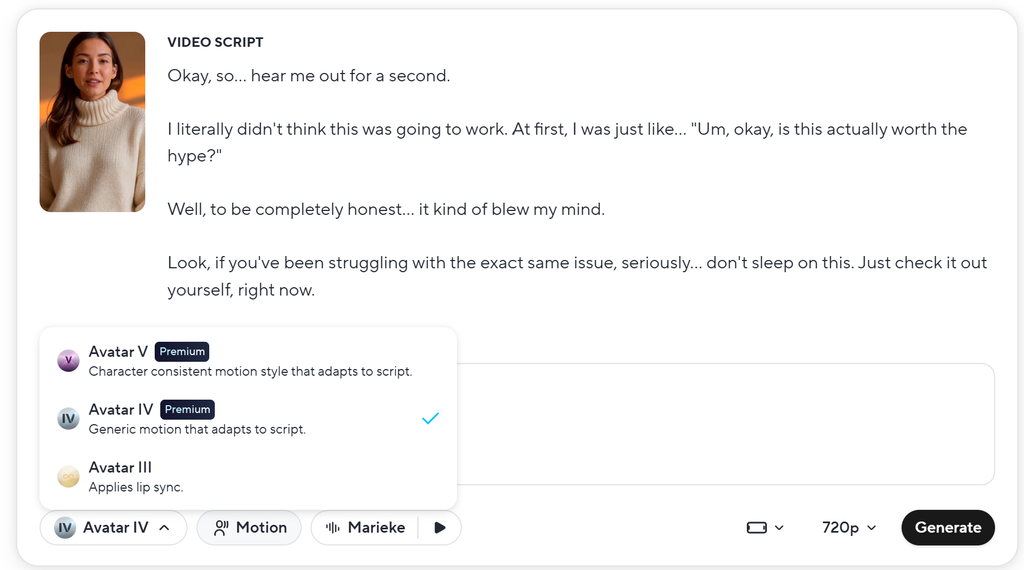
To put this to the test, I ran a 60-second ad script for a smartwatch on both platforms. I generated 35 side-by-side comparison videos across both tools to evaluate the quality.
On HeyGen, I used their latest Avatar IV engine to render 1080p videos. A 60-second clip took roughly 5.5 minutes to render. The resulting avatar was stunningly realistic, with natural eye movements, realistic blink rates, and subtle head tilts. The overall texture was incredibly smooth, leaving virtually no visible trace of AI synthesis.
While Arcads rendered faster (averaging about 3 minutes per video), the output had noticeable issues in detail.
During my testing of Arcads’ product unboxing feature, I hit a 18% video failure rate. The avatar’s hands glitched and clipped through the strap when picked up, and finger movements occasionally warped. Furthermore, in fast-talking ad scenarios, about 14% of the videos suffered from lip-sync drift and desynchronized audio-video outputs.
Round 3: Hidden Costs & Billing Transparency
In terms of cost predictability and billing flexibility, HeyGen is much more customer-friendly.
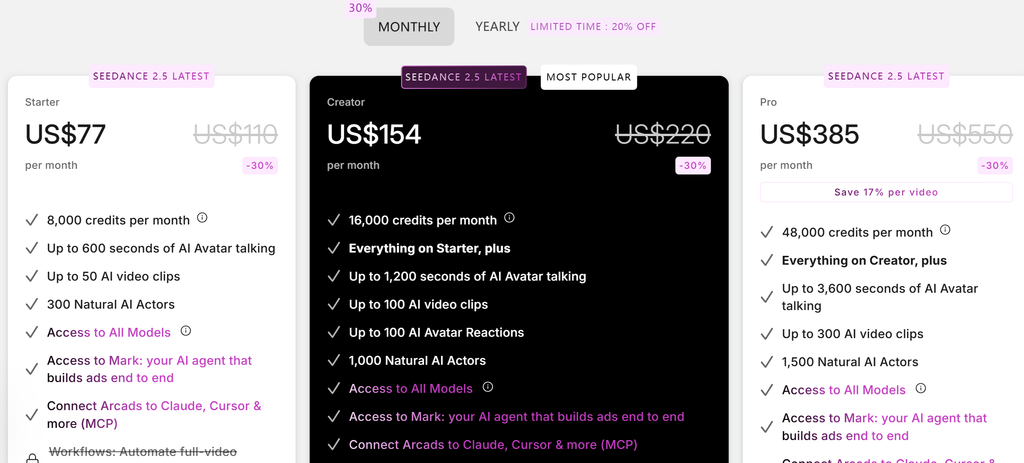
One of the biggest frustrations with Arcads is its charging mechanics. Although the Starter plan gives you 8,000 credits, it enforces a “round up to the nearest minute” rule. This means if you are producing a quick 15-second or 20-second TikTok ad, the system still deducts a full minute’s worth of credits (800 credits).
Worse, any unused credits in the Starter and Creator plans expire automatically at the end of each billing cycle. You have to carefully time your usage to avoid losing what you paid for.
HeyGen, on the other hand, is far more forgiving. Although its Creator plan comes with only 200 Premium credits, it allows unlimited generation using its standard/base avatars. I frequently use these base avatars to test the copy, formatting, and layout first. Once everything is perfected, I spend my Premium credits on the high-fidelity version. This strategy has saved me hundreds of dollars in wasted credits caused by simple typos or voice adjustments.
HeyGen vs Arcads: Limitations
| Defect Category | Arcads AI Limitations | HeyGen Limitations |
|---|---|---|
| Physical Demonstrations | Avatars cannot truly hold, touch, or naturally interact with physical products. It often leads to clipping. | Also lacks support for true physical interaction. Most product demos rely on green screen overlays or picture-in-picture graphics. |
| In-App Editing | No timeline editor. Once a video is generated, you must export it and use an external tool like CapCut for post-production. | Supports basic scene stitching, but lacks precise multi-track audio control and premium transitions. |
| Cancellation & Customer Support | Must apply to cancel at least 72 hours before renewal, otherwise you are automatically billed. Customer support is notoriously slow, sometimes taking days to respond. | Frequently updates credits policies. The free tier is highly restricted, and high-res video exports require a paid plan. |
| Trustpilot Ratings | 2.5/5 stars. Negative reviews heavily cite unexpected auto-billing issues and unresponsive customer support. | 3.5/5 stars. Most complaints point to slow rendering queues and fast credit depletion. |
During my testing, I once had a typo in my script that caused the Arcads avatar to pause awkwardly. When I reached out to customer support to request a credit refund, they flatly refused, stating they are not responsible for “creative output variations”.
Meanwhile, on Reddit, many HeyGen users complain about the online editor crashing during large projects. If you have multiple scenes in a video exceeding 5 minutes, the interface lags heavily and often freezes at 97% during rendering.
2026 FAQ: Quick Answers
1. Can Arcads AI completely replace HeyGen in 2026? No, absolutely not. While Arcads aggregates multiple advanced third-party AI models, it operates primarily as a high-volume factory line for UGC ads. For official brand spokesperson videos or polished corporate training modules, HeyGen’s Avatar IV engine remains the industry gold standard for facial realism and video clarity.
2. Which tool is more cost-effective for scaling teams? It depends entirely on your video duration and testing volume. If you need to test dozens of 1-minute talking-head ad variants in multiple languages every day, Arcads’ node-based bulk distribution workflow is much cheaper at scale.
However, if you are primarily creating short 10-to-15-second social media hooks, HeyGen is much more budget-friendly. Because Arcads rounds up all short videos to a full 1-minute credit deduction, it can result in massive wasted credit overhead for short clips.
3. Does Arcads AI offer a free trial like HeyGen? No, Arcads does not offer a free video generation trial. While their landing page advertises free credits, once registered, you will find those credits only apply to their static image engine. To generate a video where an avatar actually speaks, you must add a credit card and pay the $110 Starter monthly fee.
4. Which has better lip-sync for international marketing? HeyGen is the clear winner for lip-sync and localization. HeyGen supports over 170 languages and has highly precise localized accent calibration. On the other hand, when generating non-English languages (such as German or French), Arcads has roughly a 15% probability of audio lag or lip-sync drift.
HeyGen vs Arcads: Who Should Buy Which?
Before making your choice, ask yourself one question: Is your biggest bottleneck “video production speed” or “avatar realism”?
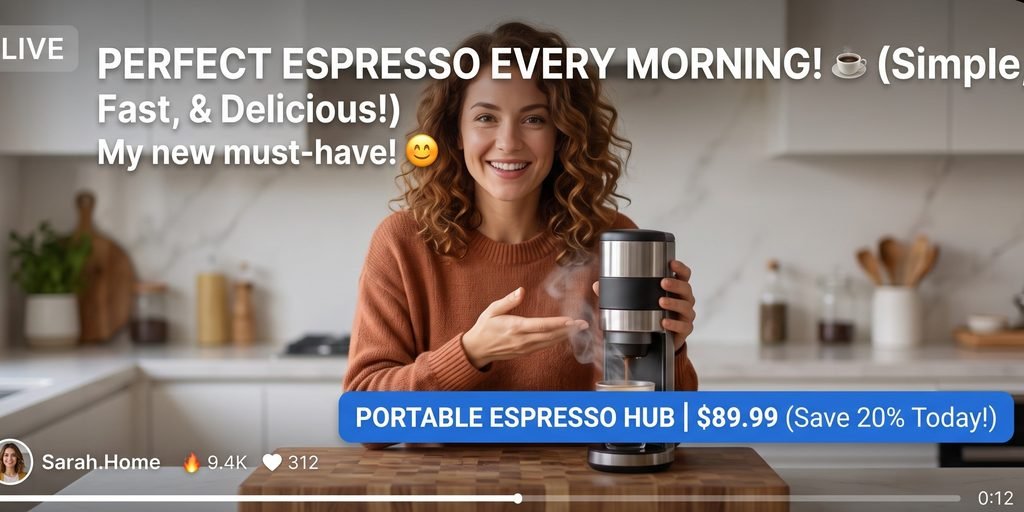
Choose Arcads AI if:
You need to churn out dozens of talking-head UGC ad variations every single day to test creatives across different faces.
Your product is digital, virtual, or SaaS-based (e.g., software, courses, virtual services) and does not require an avatar to physically hold and show a physical product.
Choose HeyGen if:
You need high-fidelity brand spokesperson videos, multilingual product demos, or a 1:1 hyper-realistic custom clone of your own face and voice.
Still exploring? Check out our other related comparisons below:
Revid vs HeyGen: AI Video Generator Honest Review
HeyGen vs Arcads: Review After Months of Use 2026



[…] and testing new video ads, and I love trying out different AI video generation tools—including Arcads and MakeUGC. Today, I’ll share my experience using both Arcads and MakeUGC, along with […]
[…] HeyGen vs Arcads: My Review […]